


Powersports ECUs have become as complex as car ECUs, and they hold back just as much. Superbikes leave the factory with a 299 km/h limiter, adventure bikes with soft throttle maps for emissions homologation, side-by-sides with speed caps and turbo UTVs with conservative boost. For a workshop that already flashes cars, this is the same job on a smaller box. This guide lists what we supply for motorcycles, quads, side-by-sides and snowmobiles, which ECUs we work on, real Stage 1 figures from our catalogue and how to order a file.
Key facts at a glance
- What we supply: Stage 1, Stage 2 on selected platforms, RPM limit increase, Vmax (top speed limiter) removal, full decat, DTC off.
- Vehicles: road and off-road motorcycles, scooters and maxi-scooters, ATVs / quads, UTVs and side-by-sides, three-wheelers, snowmobiles.
- Coverage: more than 2,000 tested models and around 5,000 indexed powersports software versions in our solutions database.
- ECUs: Bosch (ME17, ME9, MSE, MG1), Keihin, Denso, Mitsubishi, Marelli, Continental (M3C, M4C, MSE3.7), Delphi (MT05, HC12).
- Typical Stage 1 gain: around 5–8 % peak power on naturally aspirated bikes, more on turbo UTVs, plus a cleaner response in the low and mid range.
- For whom: tuners and workshops. Files come back ready to flash, checksum corrected.
What we supply
| Solution | What it does | Typical vehicles |
|---|---|---|
| Stage 1 | Fuel, ignition, torque limiters and throttle maps optimised on a stock engine. | All road and off-road bikes, ATVs, UTVs |
| Stage 2 | Calibration for hardware changes such as a full exhaust system, air filter or cams. | Selected platforms, on request |
| RPM limit increase | Hard and soft rev limiters raised within the safe range of the engine. | Sport bikes, motocross, UTVs, quads |
| Vmax | Top speed limiter removed or raised, including gear-dependent limits. | Superbikes, hypersport, UTVs, ATVs |
| Full decat | Catalyst monitoring and rear lambda sensor switched off for a decat exhaust. | Bikes with race exhausts, UTVs |
| DTC off | Single fault codes switched off cleanly, without killing the diagnostics around them. | All platforms |
Options combine freely: a typical superbike job is Stage 1 + Vmax + full decat; a turbo UTV is often Stage 1 + Vmax + RPM limit.
What we change inside the file
Motorcycle tuning is not just more fuel and more timing. Most of the result comes from removing the small limits the factory adds for noise, emissions and homologation. Depending on the ECU, a calibration touches:
- Fuel maps: air mass, lambda targets, part-load and full-throttle fuelling.
- Ignition maps: base timing, correction factors and rev limiter.
- Torque limiters: the per-gear and per-mode torque caps that stop the engine using its full output.
- Throttle and ride-by-wire: throttle valve angles, secondary intake flaps and the WOT limiter, for a sharper and more linear response.
- Gear-based limits: some bikes are restricted in the first gears, for example early Kawasaki ZX-14R models.
- Quickshifter: shorter up and down shift dead-times where the ECU supports it.
- Auxiliary systems: EXUP and other exhaust valves, second lambda sensor and catalyst monitoring, idle speed.
What to expect. On a naturally aspirated motorcycle, Stage 1 typically adds around 5–8 % peak power. The bigger difference is felt in the low and mid range and in throttle response. Turbocharged and supercharged engines (Kawasaki H2, Can-Am Maverick, Polaris RZR Turbo) gain more.
Which ECUs we work on
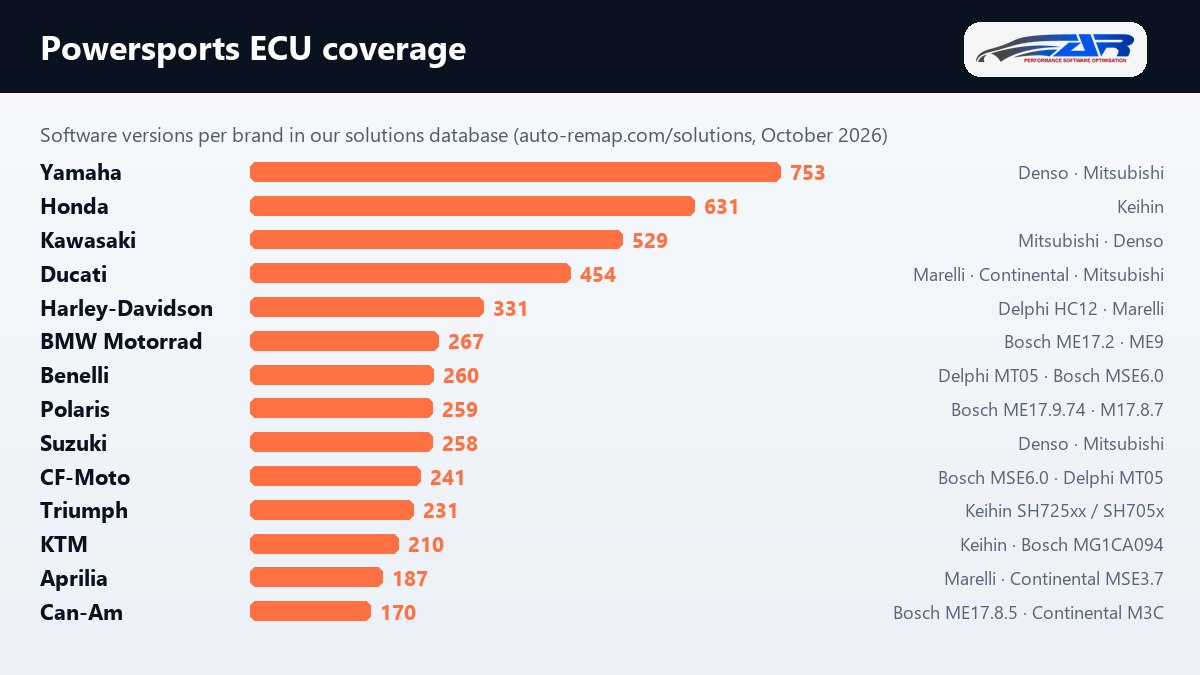
Every software version we have already processed is indexed in our solutions database, so you can check a file before you take the bike apart. The main controllers per brand:
| Brand | Main ECUs | Versions | Links |
|---|---|---|---|
| Yamaha | Denso 8591A family, Mitsubishi | 753 | catalogue · solutions |
| Honda | Keihin 38770 / 38780 | 631 | catalogue · solutions |
| Kawasaki | Mitsubishi F8T, Denso 21175 | 529 | catalogue · solutions |
| Ducati | Marelli 5AM / 7SM / 59M, Continental M3C, Mitsubishi | 454 | catalogue · solutions |
| Harley-Davidson | Delphi HC12, Marelli | 331 | catalogue · solutions |
| BMW Motorrad | Bosch ME17.2 (BMS-O, BMS-MP, BMS-X), ME9 (BMS-K) | 267 | catalogue · solutions |
| Benelli | Delphi MT05, Bosch MSE6.0 | 260 | catalogue · solutions |
| Polaris | Bosch ME17.9.74, M17.8.7, MG1CA007 | 259 | catalogue · solutions |
| Suzuki | Denso 32920, Mitsubishi | 258 | catalogue · solutions |
| CF-Moto | Bosch MSE6.0 / MSE8.0, Delphi MT05 | 241 | catalogue · solutions |
| Triumph | Keihin SH72531 / SH7054 | 231 | catalogue · solutions |
| KTM / Husqvarna / GasGas | Keihin, Bosch MG1CA094, Continental M4C | 262 | catalogue · solutions |
| Aprilia | Marelli MM11MP / 7SM, Continental MSE3.7 | 187 | catalogue · solutions |
| Can-Am | Bosch ME17.8.5, Continental M3C / MSE3.7 | 170 | catalogue · solutions |
| Royal Enfield | Continental M4C / M4A, Bosch ME17.9.71 | 16 | catalogue · solutions |
Also covered: Moto Guzzi, MV Agusta, Indian, Kymco, SYM, Piaggio and Vespa, Segway, Sherco, Voge, Zontes, QJ Motor and others. The full list is on the motorcycles & quads catalogue.
Stage 1 figures: motorcycles
Examples from our catalogue (stock → Stage 1). Each model page shows the full engine list and the dyno curve.
| Model | Power | Torque |
|---|---|---|
| Kawasaki Ninja H2R | 326 → 335 hp | 165 → 175 Nm |
| Kawasaki H2 (998 supercharged) | 231 → 240 hp | 142 → 150 Nm |
| Ducati Panigale V4 R | 221 → 230 hp | 112 → 120 Nm |
| BMW M 1000 RR (Euro 5+) | 218 → 225 hp | 113 → 120 Nm |
| Aprilia RSV4 1100 | 217 → 225 hp | 122 → 130 Nm |
| Honda CBR1000RR-R Fireblade | 217 → 225 hp | 112 → 120 Nm |
| Suzuki GSX-R1000 / R | 202 → 210 hp | 118 → 125 Nm |
| Yamaha YZF-R1 | 200 → 210 hp | 113 → 120 Nm |
| KTM 1390 Super Duke R | 190 → 200 hp | 145 → 155 Nm |
| Triumph Speed Triple 1200 RS | 180 → 185 hp | 125 → 130 Nm |
| Harley-Davidson Pan America 1250 | 150 → 160 hp | 129 → 135 Nm |
| CF-Moto 800 MT | 95 → 100 hp | 77 → 85 Nm |
| Royal Enfield Interceptor 650 | 47 → 50 hp | 52 → 55 Nm |
ATV, UTV and side-by-side
Side-by-sides and quads are where tuning pays off fastest. Turbo UTVs respond strongly to boost and ignition, and almost every model carries a factory speed limit that customers want removed for competition and private-land use.
| Model | ECU (where confirmed) | Stage 1 |
|---|---|---|
| Polaris RZR Pro R 2.0T | Bosch MG1CA007 | 225 → 255 hp |
| Can-Am Maverick R 1000 Turbo RR | — | 200 → 220 hp |
| Polaris RZR Turbo R / Pro XP (0.9T) | — | 181 → 195 hp |
| Can-Am Maverick X3 X MR | Bosch ME17.8.5 | 172 → 185 hp |
| Polaris RZR XP Turbo S | Bosch ME17.9.74 | 168 → 180 hp, 155 → 175 Nm |
| Can-Am Maverick X3 | Bosch ME17.8.5 | 154 → 165 hp |
| Segway Villain SX10 | — | 105 → 115 hp, 98 → 105 Nm |
| Kymco MXU 700i | — | 48 → 55 hp, 58 → 65 Nm |
Can-Am Outlander, Renegade and Defender (Rotax 450 to 1000R) use Continental M3C, Delphi MT05 and Bosch ME17.8.5. They are covered in detail in our Can-Am and BRP ATV article. For Polaris RZR, General, Ranger and Sportsman, see the dedicated Polaris ECU tuning guide. CF-Moto CForce and ZForce run Bosch MSE6.0 / MSE8.0 and Delphi MT05, the same families as their road bikes.
Snowmobiles and three-wheelers
Ski-Doo snowmobiles use the same Bosch ME17.8.5 family as Can-Am and Sea-Doo Rotax engines, and Arctic Cat mostly Continental M3C. Can-Am Spyder and Ryker three-wheelers (Rotax 1330 ACE, 115 → 125 hp Stage 1 on the 1.3) are handled like any other Bosch Rotax file: Stage 1, RPM limit, Vmax and DTC off.
RPM limit and Vmax explained
The rev limiter is usually a set of thresholds: a soft cut that retards ignition or closes the throttle, and a hard fuel or spark cut. Many bikes also have lower limits in neutral, in the first gears or while the engine is cold. We raise the limits the customer asks for and keep the protections that matter, such as the cold-engine limit and overheating protection.
The top speed limiter (Vmax) on most superbikes sits at 299 km/h (186 mph), an industry convention since the early 2000s. Some models limit speed per gear, and UTVs and ATVs often carry a fixed limit, sometimes tied to the key or ride mode. Removing it is a calibration change only. The gearing, tyres and chassis are the real limit.
Full decat and DTC off
A decat or race exhaust without the catalyst makes the ECU log catalyst-efficiency and rear-lambda faults, light the warning lamp and sometimes cut power. Our full decat option disables catalyst monitoring and the rear lambda sensor, and adapts fuelling where needed. DTC off switches off single fault codes, for example a removed EXUP servo, an aftermarket exhaust valve or an unused sensor, without disabling the rest of the diagnostics.
Off-road and competition only. Removing the catalyst, the speed limiter or emission-related diagnostics is intended for racing, closed-course and private-land use, in countries where such modification is permitted.
Reading the ECU: what we need from you
- A full original read. Many motorcycle ECUs can be read through the diagnostic socket. Others, especially Keihin SH705x and older Marelli units, need bench or boot mode with your tool.
- Vehicle data: model, year, engine and the ECU part number or software ID from the label or the read.
- Hardware changes: exhaust, air filter, cams or turbo kit. Stage 2 is calibrated to the parts actually fitted.
- The options you need: Stage 1, Stage 2, RPM limit, Vmax, full decat, DTC off (with the codes).
How to order a motorcycle or UTV file
All orders go through our file service, fs.auto-remap.com. Registration is free, with no subscription: you pay per file.
- Log in at fs.auto-remap.com or create a workshop account.
- Start a new order and pick the motorcycle, quad or UTV from the vehicle list.
- Upload the original read and tick the options: Stage 1, Stage 2, RPM limit, Vmax, full decat, DTC off.
- Receive the modified file, checksum corrected and ready to flash. Support stays open until the vehicle runs clean.
Can't find a model in the list? Send the read anyway. We add new models and ECUs to the platform all the time.
File service for professional tuners and workshops.
Frequently asked questions
How much power does Stage 1 add on a motorcycle?
Around 5–8 % peak power on a naturally aspirated bike, with a clearly better response in the low and mid range. Turbo and supercharged engines gain more: up to 30 hp on a Polaris RZR Pro R 2.0T.
Can you remove the 299 km/h limiter?
Yes, on the bikes that have it, together with gear-dependent limits where they exist. The Vmax option can be ordered on its own or with Stage 1.
Can the RPM limit be raised safely?
Yes, within the mechanical limits of the engine. We raise the limiter by a sensible margin and keep the cold-engine and overheating protections.
Do you calibrate for a full exhaust system?
Yes. That is our Stage 2, calibrated for the parts actually fitted. Combined with full decat, it removes the catalyst and rear-lambda faults as well.
Can a single fault code be switched off?
Yes. DTC off disables only the codes you name, for example an EXUP servo, a secondary air system or an unused sensor.
Do you work on quads, UTVs and snowmobiles?
Yes: Can-Am, Polaris, CF-Moto, Segway, Kymco, Arctic Cat, Ski-Doo and more, with the same options as motorcycles.
Which tool do I need to read the ECU?
Your usual tuning tool. Many bikes read through the diagnostic socket; some ECUs need bench or boot mode. Send us the vehicle data first if you are unsure.
Can the bike go back to stock?
Yes. Keep the original read: it can be written back at any time.
Ready to order? Go to fs.auto-remap.com, pick the bike, quad or UTV and tick the options you need. The file comes back ready to flash.
Power figures are catalogue values for stock vehicles and vary with fuel, condition and measuring method. Speed limiter, catalyst and emission-related modifications are supplied for off-road, racing and private-land use only, in territories where such modification is permitted. It is the customer's responsibility to comply with local legislation.