
Language: English · Русский · Español · Türkçe · Polski
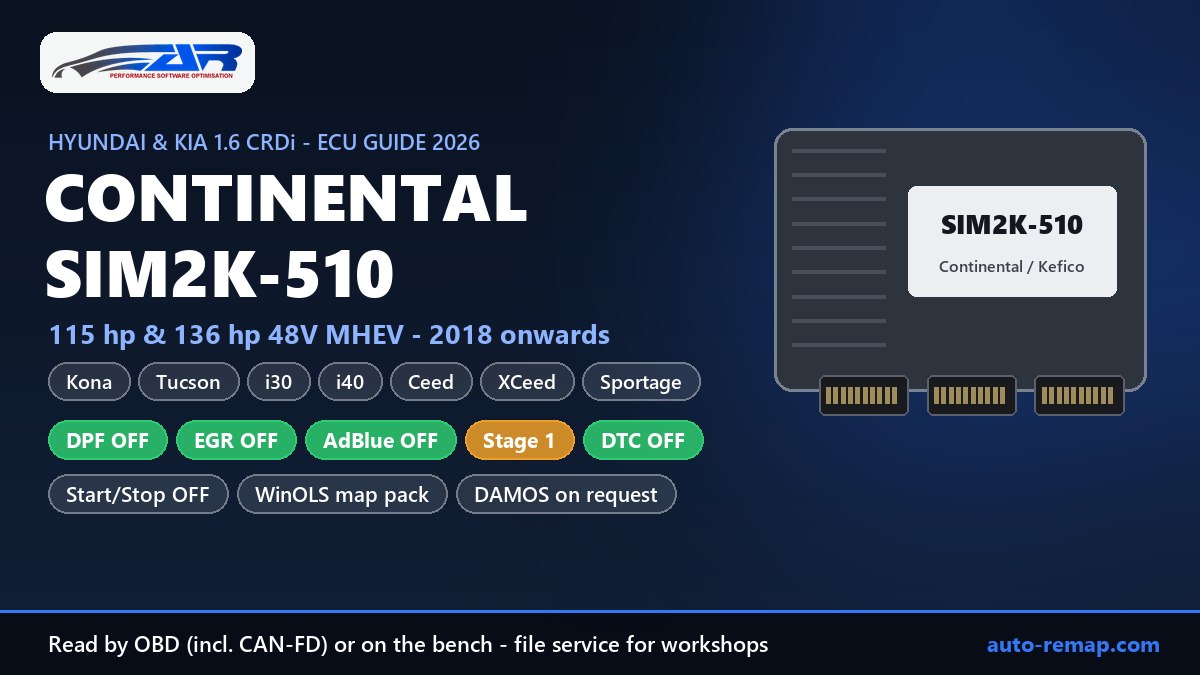
The Continental SIM2K-510 is the engine ECU of the newest Hyundai and Kia small diesels — the 1.6 CRDi in the Kona, Tucson, i30, Ceed, XCeed, Sportage and Stonic, including the 136 hp 48V mild-hybrid versions. For years it was one of the hardest units to work with: no tool could read it over OBD, and workshops were left with emulators for AdBlue and DPF problems.
That has just changed. Reading by OBD has arrived in the professional tools, and we have finished our own software solutions for this ECU — DPF, EGR and AdBlue/SCR OFF, Stage 1, Start/Stop OFF and selective DTC OFF, plus WinOLS map packs and DAMOS for almost any software version on request. This guide shows which cars carry the SIM2K-510, how to read it, what we do in the file and how to order.
Key facts at a glance
- Which cars: Hyundai Kona, Tucson (TL facelift and NX4), i30, i40 and Kia Ceed, ProCeed, XCeed, Sportage (QL facelift and NQ5), Stonic — all with the 1.6 CRDi diesel, 115 hp or 136 hp 48V MHEV, from about 2018.
- The ECU: Continental SIM2K-510, built for Hyundai Motor Group and also listed as Kefico SIM2K-510; a 32-bit Infineon AURIX controller.
- Reading: OBD (newer cars on CAN-FD) or on the bench. We work with a full read and with an OBD calibration read.
- Solutions: DPF OFF, EGR OFF, SCR/AdBlue OFF, Stage 1, Start/Stop OFF and DTC OFF — any combination in one file. The current price for your car is shown in the file service and in our tuning catalog.
- Map packs and DAMOS: a full WinOLS map pack for the 1.6 CRDi calibrations, and DAMOS for almost any software version on request.
- Complete AdBlue solution: everything is done in the engine ECU software — no emulator, and the AdBlue control module (DCU / ACM) can be removed: the car runs without it, with no warnings.
What the SIM2K-510 is
SIM2K is the family of engine control units that Continental (formerly Siemens VDO) develops for Hyundai Motor Group. Most SIM2K versions run petrol engines — the SIM2K-24x units in the 1.6 T-GDI and 2.0 T-GDI, for example. The SIM2K-510 is the diesel member of the family: it controls the 1.6 CRDi U-series engine (marketed on newer models as Smartstream D1.6) in its 115 hp and 136 hp versions.
Inside is a 32-bit Infineon AURIX controller with several megabytes of flash. The software is split into a bootloader, the program and the calibration. On the newest cars the ECU talks to the diagnostic port over CAN-FD, the faster CAN standard Hyundai and Kia introduced on their recent platforms.
The emission hardware around it is complete: diesel particulate filter, high- and low-pressure EGR, NOx sensors and, on Euro 6d versions, SCR with AdBlue — the AdBlue dosing has its own control module (DCU, often called ACM in workshops), but the engine ECU decides whether the SCR system is active.
Which Hyundai and Kia models use it
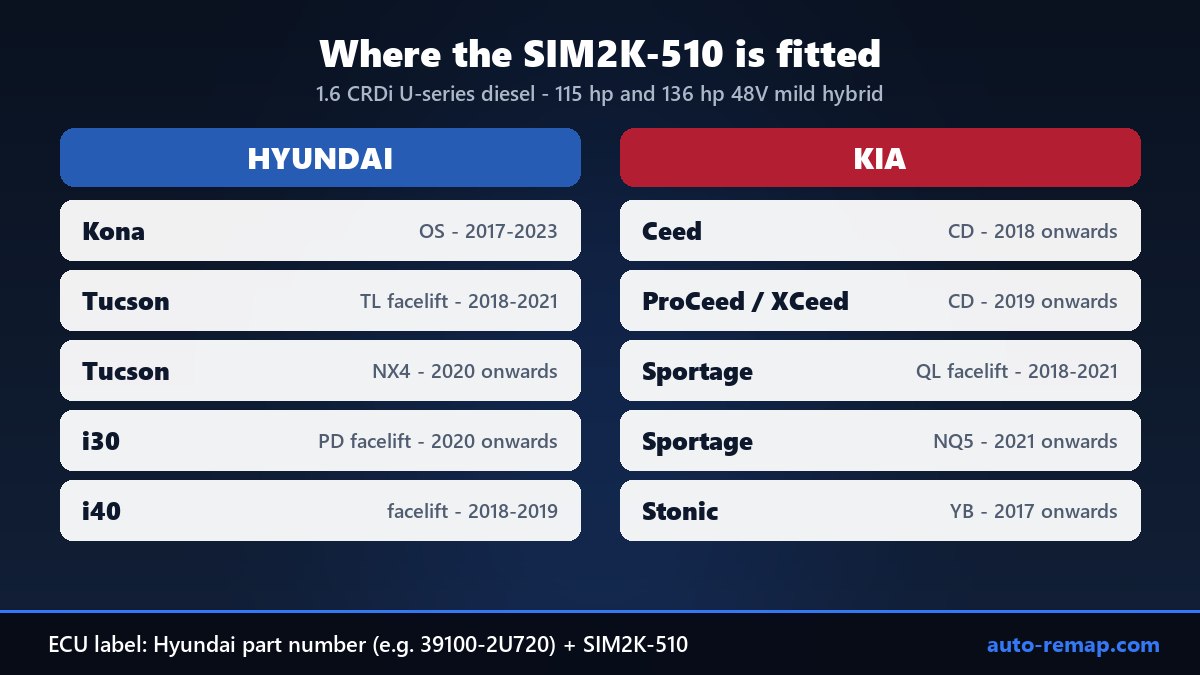
| Brand | Model | Generation | Engine | Stage 1 (our catalog) |
|---|---|---|---|---|
| Hyundai | Kona | OS, 2017–2023 | 1.6 CRDi 115 hp · 136 hp 48V MHEV | 115 → 145 hp · 136 → 160 hp |
| Tucson | TL facelift, 2018–2021 | 1.6 CRDi 115 hp · 136 hp 48V MHEV | 115 → 145 hp · 136 → 160 hp | |
| Tucson | NX4, 2020 onwards | 1.6 CRDi 115 hp · 136 hp 48V MHEV | 115 → 145 hp · 136 → 160 hp | |
| i30 | PD facelift, 2020 onwards | 1.6 CRDi 115 hp · 136 hp 48V MHEV | 115 → 145 hp · 136 → 160 hp | |
| i40 | facelift, 2018–2019 | 1.6 CRDi 115 hp · 136 hp | 115 → 145 hp · 136 → 160 hp | |
| Kia | Ceed | CD, 2018 onwards | 1.6 CRDi 115 hp · 136 hp 48V MHEV | 115 → 145 hp · 136 → 160 hp |
| ProCeed | CD, 2019 onwards | 1.6 CRDi 136 hp 48V MHEV | 136 → 160 hp | |
| XCeed | CD, 2019 onwards | 1.6 CRDi 115 hp · 136 hp 48V MHEV | 115 → 145 hp · 136 → 160 hp | |
| Sportage | QL facelift, 2018–2021 | 1.6 CRDi 115 hp · 136 hp 48V MHEV | 115 → 145 hp · 136 → 160 hp | |
| Sportage | NQ5, 2021 onwards | 1.6 CRDi 115 hp · 136 hp 48V MHEV | 115 → 145 hp · 136 → 160 hp | |
| Stonic | YB, 2017 onwards | 1.6 CRDi 110 / 115 hp | 110 → 145 hp · 115 → 160 hp |
The list follows our file-service vehicle database and the vehicle lists published by the tool makers. Torque goes from 260 to about 320 Nm on the 115 hp version and from 280 to about 330 Nm on the 136 hp version; exact figures per car are on the linked catalog pages. Other Hyundai and Kia diesels — the older 1.7 CRDi and the 2.0 / 2.2 CRDi — use Bosch EDC17 or Delphi ECUs instead, and the petrol 1.6 T-GDI uses other SIM2K versions.
Check the ECU, not only the model. Engine and ECU changed during production of several of these cars. If the car is from 2018 or later and has the 1.6 CRDi, it is almost certainly a SIM2K-510 — your tool will confirm it in seconds.
How to recognise the ECU
- The label carries a Hyundai part number (for example
39100-2U720), a Continental serial number and the text SIM2K-510. - Your tool identifies it as Continental, Kefico or Siemens SIM2K-510 — the name depends on the tool, the unit is the same.
- The software ID in the file starts with the calibration name of the vehicle line. Send us the read and we will tell you which version you have and which options are available for it.
Reading: OBD, CAN-FD and bench
Until recently the SIM2K-510 could not be read by OBD at all. In 2026 professional tools added support: Magic Motorsport, for example, announced OBD reading and writing for the SIM2K-510 on Hyundai and Kia with automatic unlock, including the CAN-FD versions (writing on CAN-FD needs their newer adapter). Bench and boot reading of the unit is also possible.
| Read type | What it contains | What we can do with it |
|---|---|---|
| OBD | The calibration area — maps, limits and switches | All options: DPF, EGR, AdBlue/SCR, Stage 1, Start/Stop, DTC OFF |
| Full read (bench / boot) | Bootloader, program and calibration | All options, plus the best basis for a map pack and DAMOS |
Always keep the original read. If you do not have one, look in our original files database for SIM2K-510.
Our solutions
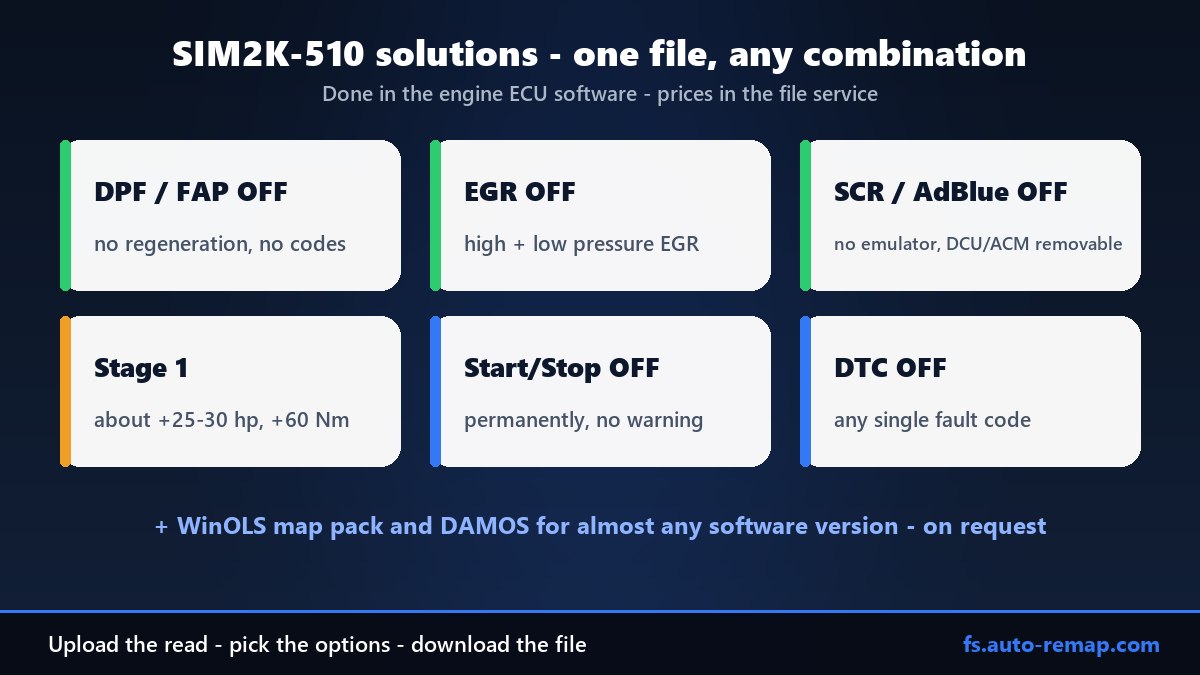
| Option | What it does |
|---|---|
| DPF / FAP OFF | Regeneration, soot model, differential-pressure monitoring and related codes disabled |
| EGR OFF | High- and low-pressure EGR, the exhaust back-pressure flap and related codes |
| SCR / AdBlue OFF | SCR system configured off in the engine ECU, inducement countdowns and AdBlue warnings removed — works with the AdBlue module (DCU / ACM) removed |
| Stage 1 | More power and torque within safe limits (see below) |
| Start/Stop OFF | Automatic engine stop disabled permanently |
| DTC OFF | Any individual fault code disabled — the ECU has about a thousand diagnostic events |
Options can be combined freely in one file. The current price for your exact vehicle and each option is shown in the file service when you place the order; per-engine prices are also listed on the vehicle pages of our tuning catalog.
What we change in the file
DPF OFF
The regeneration strategy and the soot model are switched off, so the ECU no longer requests regenerations or post-injection. Monitoring of the differential-pressure sensor and the particulate filter efficiency is disabled, and the related fault codes and warning lights are removed. Combined with EGR OFF it gives a clean, stable engine without the classic short-trip problems.
EGR OFF
The 1.6 CRDi uses both a high-pressure EGR valve and a low-pressure EGR loop with an exhaust back-pressure flap. We close the EGR in every operating mode, take the flap out of the control loop and remove the related codes (EGR flow, position, cooler and flap circuits such as P0475–P0478). The air path is recalibrated so the engine runs as if the system were healthy.
SCR / AdBlue OFF
On Euro 6d versions the AdBlue dosing has its own control module (DCU / ACM), but the engine ECU decides whether the SCR system exists. We configure the SCR system off in the engine ECU, neutralise the inducement logic (the distance countdown to a start inhibit) and remove the AdBlue, NOx-efficiency and communication codes — including the codes for the missing module.
A complete solution — the AdBlue module can be removed. The modified file works with the DCU / ACM disconnected or taken out of the car: no communication errors, no AdBlue warnings, no countdown. No emulator and no extra wiring are needed. You can also leave the module in place — the file works either way.
Start/Stop OFF
The automatic stop is disabled in the engine ECU itself, including the temperature conditions it uses, so the system stays off after every start — no button press, no warning on the dashboard.
DTC OFF
The SIM2K-510 keeps about a thousand diagnostic events in its own tables. We disable exactly the codes you name — for a removed sensor, a known false alarm or a component that is no longer fitted — and leave all other diagnostics as from the factory.
Stage 1: power and torque
| Engine | Stock | Stage 1 |
|---|---|---|
| 1.6 CRDi 115 hp | 115 hp / 260 Nm | about 145 hp / 320 Nm |
| 1.6 CRDi 136 hp (48V MHEV) | 136 hp / 280 Nm | about 160 hp / 330 Nm |
Stage 1 is calibrated on the real limiters of this ECU: the torque limitation, the smoke limiter by air mass, injection quantity and timing per combustion mode, rail pressure and boost. Rail pressure and boost stay within the limits of the stock hardware, and the gearbox torque limits are respected — on manual and DCT versions alike. The mild-hybrid 48V system keeps working as before.
WinOLS map packs and DAMOS
Tuners who prefer to write the file themselves can order a WinOLS map pack for the SIM2K-510. For the reference 1.6 CRDi calibrations it contains more than 1,300 named maps — torque and smoke limiters, injection and rail-pressure maps per combustion mode, boost, EGR, DPF, SCR, Start/Stop and the diagnostic tables — with correct axes, factors and units. For other software versions the maps are transferred and checked against the program code before delivery.
We also create DAMOS files for almost any SIM2K-510 software version on request. Send the read, we check the version and quote the price and delivery time. Read more about custom DAMOS creation or browse the map pack database.
How to order
- Read the ECU by OBD or on the bench and keep the original.
- Register in the AUTO-REMAP file service, choose Hyundai or Kia, the model and the 1.6 CRDi engine.
- Upload the read and tick the options — DPF, EGR, AdBlue, Stage 1, Start/Stop, DTC OFF in any combination.
- Download the modified file with corrected checksums and write it back with your tool.
- For a map pack or DAMOS, write to us with the read attached — we answer every day on WhatsApp and Telegram.
Questions and answers
Which cars use the SIM2K-510?
Hyundai Kona, Tucson, i30 and i40 and Kia Ceed, ProCeed, XCeed, Sportage and Stonic with the 1.6 CRDi diesel (115 hp or 136 hp 48V MHEV), from about 2018.
Can the SIM2K-510 be read by OBD?
Yes. Professional tools added OBD support in 2026, including the CAN-FD versions. Bench and boot reading is also possible.
Is an OBD read enough?
Yes, for all our options. A full bench read is preferred when you order a map pack or DAMOS.
Do I need an AdBlue emulator or the AdBlue module?
No to both. The SCR system is configured off in the engine ECU software, and the inducement countdown, warnings and communication codes are removed there. The solution is complete: the car works with the AdBlue control module (DCU / ACM) removed, and no emulator is needed.
Is the SIM2K-510 the same as the SIM2K-241 or SIM2K-245?
No. Those are petrol versions of the same family (T-GDI and MPI engines). The SIM2K-510 is the diesel ECU of the 1.6 CRDi.
Does Stage 1 work on the 48V mild-hybrid versions?
Yes. The 48V system keeps working; Stage 1 changes the diesel engine calibration only.
Can I get a WinOLS map pack or DAMOS for my software version?
Yes, for almost any version on request. Send the read and we will confirm the version, price and delivery time.
How much does it cost?
The price depends on the vehicle and the options you choose. The file service shows the current price for your exact car when you place the order, and the vehicle pages of our tuning catalog list the per-engine prices.
Have a Hyundai or Kia 1.6 CRDi with the SIM2K-510? Upload the read to fs.auto-remap.com, pick the options and download the file — or ask us for a map pack or DAMOS for your software version.
File service for professional tuners and workshops.
The price shown in the file service at the time of ordering applies. Power figures are typical values from our tuning catalog. Emission-related modifications are supplied for off-road, motorsport, export and research use only, in territories where such modification is permitted. It is the customer's responsibility to comply with local legislation.