


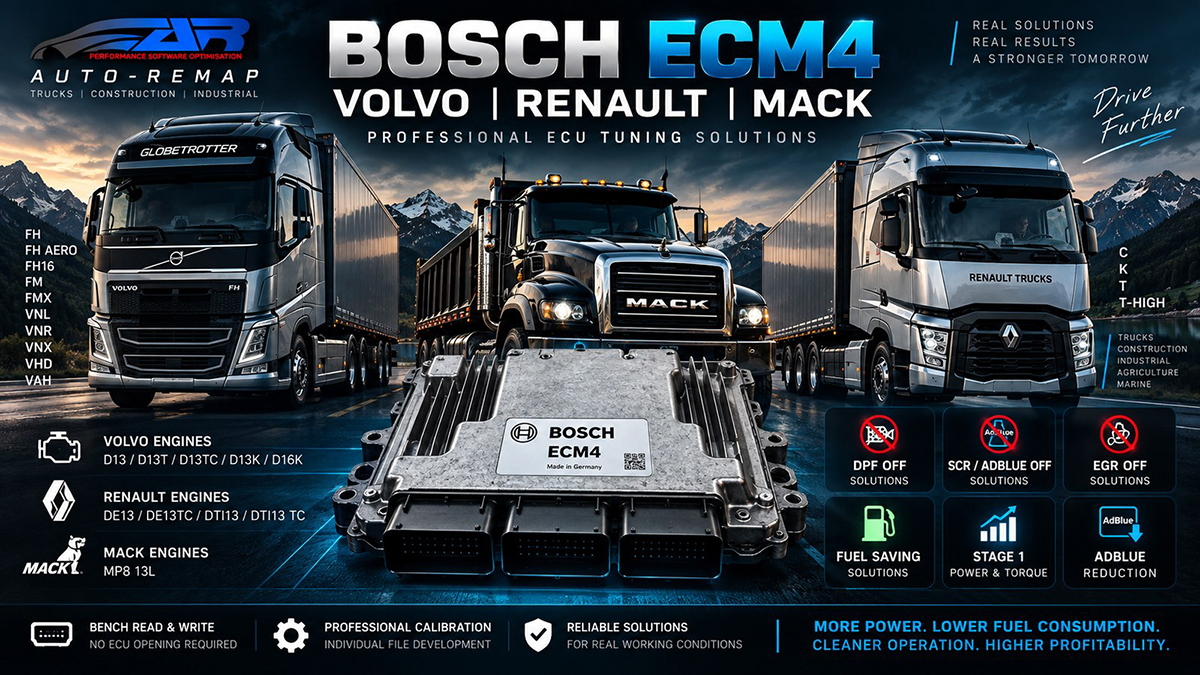
The Bosch ECM4 is the engine control unit that replaced TRW EMS 2.3/2.4 on the Volvo Group 11-, 13- and 16-litre platform. For three years it was a closed box: no reliable read, no write, no calibration work. That has changed — the major tool makers have opened bench read and write on ECM4, and the whole Volvo / Renault / Mack heavy-duty range from 2022 onwards became serviceable again.
Key facts at a glance
- What it is: Bosch ECM4 — fourth-generation Volvo Group engine ECU, Infineon AURIX TC299 microcontroller, fitted from model year 2022.
- Where it is fitted: Volvo FH / FH Aero / FM / FMX / FH16 and VNL / VNR / VNX / VHD / VAH, Renault T / T High / C / K, Mack Anthem / Pinnacle / Granite / TerraPro, plus TAD11 / TAD13 / TWD16 industrial engines.
- Access: bench only, at the ECU connector — the unit is not opened and does not have to be removed.
- Timings: ≈ 3 min 15 s read, ≈ 1 min 30 s write, automatic checksum correction, backup before write.
- Second ECU: AdBlue dosing lives in a separate ACM module — any SCR work needs both files.
- What we supply: EGR OFF, DPF/DOC OFF, SCR/AdBlue OFF, AdBlue reduction 50–70 %, Stage 1 ECO tuning with up to 4–5 l/100 km saved.
For us this is not a new project — it is the same ECU, one generation on. We have been writing manual solutions for the Volvo Group engine and aftertreatment architecture since 2014, across 150+ tested models and software structures on TRW EMS 2.0 / 2.2 / 2.3 / 2.4 together with the Continental ACM AdBlue module. ECM4 keeps that architecture: the same two-ECU logic, the same SCR/DPF/EGR strategy layout, and the same rule that a correct job means touching both control units. Our TRW know-how transfers directly.
What the Bosch ECM4 actually is
ECM4 (Engine Control Module, generation 4) is Volvo Group's current engine controller, built by Bosch on modern MD1-class hardware and fitted from model year 2022 on the D11 / D13 / D16 family and its Renault (DE / DTi) and Mack (MP) derivatives. It runs the injection strategy, EGR, exhaust thermal management and DPF regeneration; urea dosing and NOx accounting sit in the separate ACM aftertreatment module. Anything that touches the emissions chain therefore touches two files, not one.
ECM4 vs TRW EMS 2.3 / 2.4
| Parameter | Bosch ECM4 | TRW EMS 2.3 / 2.4 |
|---|---|---|
| Microcontroller | Infineon AURIX TC299 | Freescale/NXP MPC5xxx family |
| Vehicle generations | 2022+ (Euro 6 Step E, EPA21/EPA24) | ≈ 2013–2022 (Euro 6 Step A–D) |
| Access method | Bench — ECU connector, unit not opened | OBD / bench, depending on tool |
| Read type | Calibration read, ≈ 3 min 15 s | Full / calibration read |
| Write time | ≈ 1 min 30 s | 3–15 min depending on protocol |
| Checksum | Automatic correction supported | Automatic correction supported |
| Backup | Backup created before write | Backup created before write |
| Aftertreatment control | Separate ACM module | Separate ACM 2.1 module |
The practical point: ECM4 is read and written on bench, at the connector — the ECU stays on the truck, nothing is opened, nothing is desoldered. You need the correct bench harness, a stable 12/24 V supply and a tool with ECM4 support. Boot mode and OBD flashing are not required and are currently not offered by any of the mainstream tools.
Which trucks and engines use the ECM4
Volvo Trucks and Volvo industrial engines
| Model / application | Engine | Power | ECU set |
|---|---|---|---|
| Volvo FH, FH Aero (New Generation) | D13K / D13TC (12.8 TDI) | 460–540 hp | Bosch ECM4 + ACM |
| Volvo FM, FMX | D11K / D13K | 315–540 hp | Bosch ECM4 + ACM |
| Volvo FH16, FH16 Aero | D16K (16.1 TDI) | 550–796 hp | Bosch ECM4 + ACM |
| Volvo VNL, VNR, VNX, VHD, VAH (North America) | D11 / D13 / D13TC | 375–500 hp | Bosch ECM4 + ACM |
| Loaders, excavators, gensets, marine | TAD11 / TAD13 / TWD16 | 315–796 hp | Bosch ECM4 + ACM |
Renault Trucks
| Model | Engine | Power | ECU set |
|---|---|---|---|
| Renault T, T High | DTi13 / DE13, DE13TC (12.8 TDI) | 440–520 hp | Bosch ECM4 + ACM |
| Renault C, K, D (heavy range) | DTi11 / DE11 (10.8 TDI), DTi13 | 315–520 hp | Bosch ECM4 + ACM |
Mack Trucks
| Model | Engine | Power | ECU set |
|---|---|---|---|
| Mack Anthem (2025+) | MP8 13 L | 415–505 hp | Bosch ECM4 + ACM |
| Mack Pinnacle (2025+) | MP8 13 L | 415–505 hp | Bosch ECM4 + ACM |
| Mack Granite, TerraPro | MP7 / MP8 | 325–505 hp | Bosch ECM4 + ACM |
Everything built before the ECM4 rollout is still covered by our long-standing TRW programme — MP7/MP8/MP10, DTi5/8/11/13, DXi7–13 and D4–D16 on EMS 2.0/2.2/2.3/2.4. See the detailed page: Volvo / Renault / Mack trucks & loaders with TRW EMS 2.2 / 2.3 / 2.4.
Tool support: who reads ECM4 today
| Tool | Method | Declared coverage |
|---|---|---|
| Autotuner | Bench — Normal Read, calibration, checksum correction, backup (MCU TC299) | Mack Anthem / Pinnacle MP8 13 L; Renault C / D / K / T with DTI13 440 / 480 / 520 and DTI13 TC 480; Volvo FH New Generation and FMX with D13K 460 / 500 |
| Alientech KESS3 (v3.52) | Bench — read and write at the ECU connector, no opening | ECM4 from 2022+. Mack Anthem, Granite, Pinnacle, TerraPro (MP8); Renault C, K, T, T High (DE13, DE13TC); Volvo FH, FH Aero, FM, FMX, FH16, FH16 Aero, VNL, VNR, VNX, VHD, VAH (D13, D13T, D13TC, D16K) |
| Dimsport | Bench — direct read and programming through the ECU connector | Volvo FH, FH Aero, FM; Renault T, T High, C; Mack Anthem, Pinnacle |
Coverage lists differ slightly between manufacturers and are extended with every release. If your exact model or software version is not on a list yet, send us the read attempt result — in most cases the file is already a known structure for us.
How an ECM4 is read and written on bench
- Locate the engine ECU and free the main connector. The unit stays on its bracket.
- Connect the bench harness for the Volvo Group ECM4 pinout and a stable, current-capable 12/24 V supply — voltage drop during write is the number one cause of a failed flash.
- Identify the ECU with your tool and take a calibration read (≈ 3 min 15 s). Save the backup the tool creates and keep it untouched.
- Repeat the same procedure on the ACM module if AdBlue/SCR work is part of the job.
- Send both original files to us. You receive modified files back, checksum-corrected and ready to flash.
- Write (≈ 1 min 30 s per ECU), clear the fault memory, then run a road test long enough to confirm no stored faults, no derate and no inducement countdown.
What we do with an ECM4 file
- EGR OFF — full deactivation, valve and cooler strategy removed, all related sensors can be disconnected without a fault reaction.
- DPF / DOC OFF — regeneration logic, soot and ash models, differential pressure and exhaust temperature monitoring removed.
- SCR / AdBlue OFF — complete removal across both control units (ECM4 + ACM), including NOx sensors, dosing module, level and quality sensors, torque limitation and countdown/inducement.
- AdBlue quantity reduction (50–70 %) — for fleets that must keep the SCR system physically operational but want to cut consumption. See our dedicated page on AdBlue consumption reduction by file modification.
- Stage 1 ECO tuning — torque and injection map optimisation aimed at fuel economy, verified on dyno; up to 4–5 litres per 100 km saved on long-haul duty cycles.
- DTC OFF, speed limiter, idle shutdown, PTO and drivability corrections on request.
Every file is made manually in WinOLS against your original read. No automated patchers, no generic "one-file-fits-all" — the Volvo Group software structure changes between software levels, and a blind patch is exactly how a truck ends up in limp mode 400 km from base.
Do not delete the DPF and leave AdBlue working. On this architecture the SCR and the particulate filter are one closed loop: with the DPF gone, exhaust temperature and NOx conversion models no longer match reality, dosing goes out of range and the truck will throw errors, derate, or overdose urea into a system that cannot process it. If the DPF goes, the SCR strategy must be handled in the same job — in both the ECM and the ACM. Background reading: how the catalytic-coated DPF system works.
Why ECM4 trucks come to the workshop
The complaints on the 2022+ generation are the familiar Euro 6 / EPA ones, only more expensive to fix at dealer level:
- Repeat NOx sensor failures and urea quality or dosing faults, each one dragging the truck into a derate window.
- Failed or endlessly repeating DPF regenerations on urban and low-load duty cycles, with soot and ash load never coming back down.
- Inducement countdowns and speed limitation triggered by an aftertreatment fault the fleet cannot clear on the road.
- AdBlue consumption well above the expected 4–6 % of fuel, on trucks working in heat, dust or heavy stop-start duty.
- Cost of ownership on out-of-warranty machines — a DPF, SCR catalyst or dosing module replacement on a 13-litre truck is rarely a small invoice.
These are exactly the cases where a correct, manually written ECM4 + ACM file removes the underlying strategy instead of masking a symptom.
What we need from you
- Original read of the ECM4 (bench, full or calibration as your tool delivers it).
- Original read of the ACM — mandatory for any AdBlue/SCR work.
- VIN, engine designation and power, emission level (Euro 6 Step / EPA) and the software or part numbers if you have them.
- The exact list of what has to be switched off, plus any hardware already removed from the truck.
Files are returned checksum-corrected and ready to flash. Support runs until the truck is confirmed clean — no stored faults, no derate, no inducement.
Why the ECM4 is "the same ECU" for us
New silicon, new tool protocol — but the same engineering. The Volvo Group has kept its two-controller layout since EMS 2.2: the engine ECU owns injection, EGR, DPF and exhaust thermal management, and a separate aftertreatment module owns urea dosing and NOx accounting. That means the strategy that has worked for us on 150+ TRW software structures — remove the function, remove its monitoring, keep the torque structure and the diagnostics coherent — applies one to one on ECM4. What changed is the access method, and that is now solved.
How to order an ECM4 solution
Every ECM4 job runs through our file service — fs.auto-remap.com. Registration is free, there is no subscription, and you pay per file.
- Open fs.auto-remap.com and log in, or create an account — it takes a minute.
- Start a new order and go to the Trucks section of the vehicle list.
- Find your brand in the list — Volvo, Renault or Mack — then your engine: D11 / D13 / D16, DTi11 / DTi13, MP7 / MP8.
- Select the Bosch ECM4 entry (listed together with the ACM aftertreatment module). That is the ECU covering the whole 2022+ range described on this page.
- Upload the original ECM4 read — and the ACM read as well if the job includes AdBlue or SCR — then tick the options you need: EGR OFF, DPF/DOC OFF, SCR/AdBlue OFF, AdBlue reduction, Stage 1 ECO tuning.
- Send the order. The modified files come back checksum-corrected and ready to flash, and support stays open until the truck is confirmed clean.
Not sure which entry matches your VIN or software version? Send us the vehicle data first — we confirm coverage before you take anything apart.
Email:
Frequently asked questions
Is the ECM4 just a renamed TRW EMS 2.4?
No. It is different hardware — a Bosch unit on an Infineon TC299 microcontroller, introduced from 2022. What carries over is the system architecture: an engine ECU plus a separate ACM for AdBlue dosing, and the same EGR/DPF/SCR strategy philosophy. That is why our TRW experience applies directly.
Can the ECM4 be read through OBD?
Not currently. Autotuner, Alientech KESS3 and Dimsport all support ECM4 in bench mode only. The ECU is not opened — the connection is made on the outside plug with the proper harness.
Does the ECU have to come off the truck?
No. Bench here means "at the connector". The unit stays mounted; you need the correct bench cable, a clean power supply and enough space to reach the plug.
Is the ACM read really necessary?
For AdBlue and SCR work, yes. Dosing, NOx accounting, level and quality monitoring and part of the inducement logic live in the ACM. An ECM-only file leaves half the system arguing with the other half.
Which model years are covered?
ECM4 appears from 2022 on Volvo FH, FH Aero, FM, FMX, FH16 and the North American VNL, VNR, VNX, VHD and VAH; on Renault T, T High, C and K; and on Mack Anthem and Pinnacle from 2025. Earlier trucks use TRW EMS 2.2/2.3/2.4 and are covered by our existing programme.
Do you support industrial and off-highway engines?
Yes — TAD11, TAD13 and TWD16 units in loaders, excavators, gensets and marine applications use the same ECM4 + ACM set.
What fuel saving is realistic?
On our dyno-tested Stage 1 ECO calibrations for this platform, up to 4–5 litres per 100 km on long-haul duty cycles. Real figures depend on load, route profile and driver behaviour.
How long does an ECM4 file take?
Standard turnaround on our file service is measured in hours during working time. Send the ECM4 and ACM originals together with the vehicle data and the requested option list — incomplete uploads are the usual reason a job waits.
Ready to order? Go to fs.auto-remap.com, open the truck list and pick Volvo, Renault or Mack — the Bosch ECM4 + ACM ECU is waiting there for your original file.
Emission-related modifications are supplied for off-road, motorsport, export and research use only, in territories where such modification is permitted. It is the customer's responsibility to comply with local legislation.